Play Pilot Chicken Demo
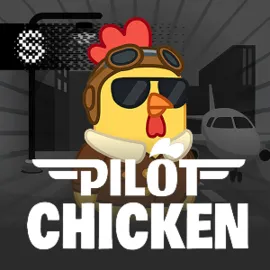
Pilot Chicken is a crash-style game by Spribe. There are no reels and no symbols. Instead, a cartoon chicken walks across an airport runway packed with planes about to take off. Each step forward raises a multiplier. You choose when to cash out. Leave it too long and the chicken gets hit, the round ends and your stake is gone. A demo is available on this page if you want to feel the mechanic before betting real money.
Key Features of Pilot Chicken
| RTP | 96% (sources differ, see below) |
|---|---|
| Volatility | Low / Medium / High, player-selectable |
| Reels and rows | Not applicable, crash-style game |
| Paylines or ways | Not applicable, crash-style game |
| Max win | 10,000x stake |
| Provider | Spribe |
| Release year | Not confirmed |
| Min bet | €0.10 |
| Max bet | €100 |
| Bonus features | Risk Level Selection, Auto Cash-Out, Multiplier Ladder |
RTP, Volatility and Max Win
RTP, Return to Player, is the percentage of all money wagered that a game pays back over a very large number of rounds. A game at 96% returns £96 for every £100 staked on average, across millions of bets. That average tells you nothing about a single session, but it lets you compare games fairly.
The RTP on Pilot Chicken is disputed. The independent review site Bigwinboard puts it at 96%, which sits right at the industry norm. Spribe’s own promotional site claims 99%. Both figures are in circulation; this review uses the 96% figure from the independent source, and you should note the discrepancy before playing.
Volatility describes how a game pays. A low-volatility game pays out frequently but in smaller amounts. A high-volatility game pays less often but can deliver much larger wins when it does hit. What makes Pilot Chicken unusual is that volatility is not fixed. You pick it yourself before each round by selecting one of three risk levels, Low, Medium or High. That choice directly changes how dangerous each step on the runway is, and how fast the multiplier grows if the chicken survives.
The confirmed max win is 10,000x your stake. At the maximum bet of €100 that would return €1,000,000, though reaching that figure would require surviving an extraordinary number of steps on the highest risk setting. There is no progressive jackpot in Pilot Chicken, every round pays out from a fixed multiplier structure.
How Pilot Chicken Plays
There are no reels, no symbols, no paylines. The entire game is a single decision repeated over and over: do I take the money now, or do I let the chicken take one more step?
Each round begins with you placing a bet and selecting a risk level. The chicken then walks forward along the runway. Every square it lands on is a manhole cover displaying the multiplier on offer at that point. Survive one obstacle and the multiplier rises. Hit a passing plane and the round ends immediately, your stake is lost.
At any moment you can press cash out. That locks in the current multiplier and your round is done. The longer you wait, the higher the potential return, and the greater the chance of losing everything.
Bet limits run from €0.10 to €100. At €0.10 per round, a session of 100 rounds costs a maximum of £10, and early cash-outs on Low risk will eat through that slowly. At €10 a round, stakes are meaningful quickly, and a bad run on High risk with no cash-out can burn through a session budget in minutes. At €100, this is a game where a single wipe-out matters. If you are still deciding where to play, our guide to Casino Applications covers more than 50 UKGC-licensed options with troubleshooting support built in.
The game runs in a browser via HTML5 and works on iOS and Android without downloading any app.
Bonus Features in Pilot Chicken
Risk Level Selection
Before every round you choose Low, Medium or High risk. This is not cosmetic. A higher risk level means the chicken is more likely to be knocked out at each step, but if it survives, the multiplier grows faster. On Low, you can build a reasonable multiplier without sweating. On High, the tension arrives from the first square. The risk level also defines the ceiling for each mode: the multiplier potential scales sharply upward as you move through the three settings. This is the closest Pilot Chicken has to a strategic layer, choosing the right level for your bankroll and temperament matters more than anything else you can control in the game.
Multiplier Ladder
Each manhole-cover square on the runway shows the multiplier value waiting at that position. You are never guessing blindly, the reward for each step is visible before the chicken takes it. That transparency is useful. It lets you set a mental target before a round begins rather than making a panicked decision in the moment. The ladder does not guarantee anything; the chicken might not make it to the next square. But it gives you a concrete number to aim for.
Auto Cash-Out
You can set a target multiplier before the round starts. If the chicken reaches that square safely, the game cashes out automatically without you having to react in real time. This removes the pressure of the manual decision and lets you play a disciplined, preset strategy. It also makes the game feel more passive, which is a downside for players who play for the tension rather than the outcome.
Auto play is also available, which sends each round through the same settings repeatedly. Combined with auto cash-out, this turns Pilot Chicken into a near-automated loop. That removes almost all of the engagement the game is built around.
Three Risk Levels: How Volatility Works in Pilot Chicken
Most crash games give you one experience. Pilot Chicken gives you three, and the difference between them is not subtle.
On Low risk, the chicken is harder to knock out early. The multiplier climbs more gently, but you will survive more steps on average. This suits players who want a longer session from a smaller budget, or anyone who wants to build familiarity with how the runway mechanics feel before raising the stakes.
Medium risk is the middle ground. Obstacles arrive more unpredictably. The multiplier moves faster but early exits happen more often. A session on Medium risk is shorter and spikier than Low, you will lose more rounds outright, but the wins that do land are bigger.
High risk is where the volatility is genuinely steep. The chicken can be eliminated from the very first square. But if it survives several steps, the multiplier accelerates quickly. This is the mode where the 10,000x max win becomes a theoretical possibility rather than a number on a spec sheet. Practically, High risk means most rounds end fast and cheap, punctuated by the occasional run that goes deep and pays well. For a session player on €0.10 bets it is sustainable. For someone on €50 bets who runs ten consecutive first-step eliminations, it depletes a budget in under two minutes.
The key point is that you are choosing a different mathematical model each time you change the risk level, not just a cosmetic difficulty setting. Players who treat Low and High as the same game with a different label will be caught off guard.
Provably Fair and How Pilot Chicken Handles RNG
Most players ask whether a crash game can be rigged. The honest answer for Pilot Chicken is that Spribe uses a provably fair system, a method of generating results using cryptographic hashes that players can verify independently after each round.
Here is what that means in plain terms. Before a round begins, the game produces a server seed, a string of data that determines the outcome. That seed is hashed, meaning it is converted into a fixed-length code that you can see but not decode before the round runs. After the round, the original seed is revealed. You can run it through a hash generator yourself to confirm that the code you were shown before the round matches the seed that produced the result. If it matches, the outcome was not changed after the fact. If you want to understand how provably fair algorithms actually work under the hood, our dedicated piece on RNGs and security walks through the cryptographic process step by step.
This is the same approach Spribe uses across its other titles, including Aviator, and it has been audited by independent testing laboratory iTech Labs for Pilot Chicken specifically. That does not mean every outcome will be in your favour, RNG results are still random. But it does mean the results cannot be manipulated by the operator or by Spribe once a round has started. For UK players in particular, who play on platforms regulated by the UK Gambling Commission, provably fair technology adds a verifiable layer of transparency on top of the standard licensing requirements.
Pros and Cons of Pilot Chicken
Pros
- Three selectable risk levels create genuinely different games within the same title
- Multiplier Ladder shows you the reward for each step before you take it
- Provably fair system lets players independently verify each result
- €0.10 minimum bet keeps Low risk sessions affordable
- Fully browser-based HTML5, no app download needed on iOS or Android
- Fast rounds suit players who want momentum rather than long waits
Cons
- The RTP figure is disputed, 96% from independent reviewers, 99% claimed by the developer’s own site
- No layered features: one decision loop, every round, no variation
- Auto play combined with auto cash-out removes most of the engagement
- High risk mode can eliminate a stake from the very first step with no recourse
- Likely to feel repetitive after a short time for players used to feature-rich slots
Verdict
Pilot Chicken does one thing and knows it. The runway mechanic is sharper than a climbing graph and the three risk levels give it more flexibility than most crash games offer. But there is nothing underneath the cash-out loop. Players who need variety, features or progression will run out of reasons to continue within a short session. The RTP dispute is worth flagging too, you should be aware that the figure you are playing against may be closer to 96% than the 99% that Spribe’s own site advertises. This is a decent game for crash genre fans who want something with a bit more character than Aviator. It is the wrong game for anyone who needs more than a single decision to stay engaged.
Who Should Play Pilot Chicken
Pilot Chicken suits players who already know and enjoy crash games. If you have spent time with Aviator or Mines and want a format where you control your own risk profile from round to round, the three-level system here gives you that directly.
Low risk on a small budget, say €0.10 to €0.50 per round, is a reasonable way to learn the mechanic without much exposure. The Multiplier Ladder makes the learning curve fast, since you can see exactly what each step is worth before the chicken takes it.
High risk at any meaningful stake is a different proposition. It suits players who are comfortable with frequent full-stake losses in exchange for occasionally deep runs. Anyone who finds that kind of variance uncomfortable should stay on Low or Medium.
Players who want free spins, bonus rounds, symbol combinations or anything resembling a traditional slot should look elsewhere. This game has none of that. It is a decision loop with a cartoon skin, and it does not pretend otherwise.
UK players: Pilot Chicken is a very new title, launched in early 2026. Check whether it is available at your chosen UKGC-licensed casino before depositing. If you need support with gambling habits, BeGambleAware and GamStop are the relevant organisations for UK players. You can block access to all licensed gambling sites immediately via gamstop.co.uk, the UK’s free self-exclusion service.
About Spribe
Spribe is the studio behind Aviator, the crash game that established the genre as a mainstream casino format. Founded in 2018 and holding licences including those from the Malta Gaming Authority and the UK Gambling Commission, Spribe built its catalogue around provably fair mechanics and HTML5 delivery. Pilot Chicken sits within that catalogue as a single-player crash title, following the same design philosophy as the studio’s other Turbo Games, fast rounds, minimal friction, and player-controlled risk.
Frequently Asked Questions
What is the RTP of Pilot Chicken?
The independent review site Bigwinboard states 96%, which is the figure this review uses. Spribe’s own promotional site claims 99%. The two figures are in direct conflict and neither has been independently verified by this page. If the RTP matters to your decision, be aware of that gap before you play.
Is Pilot Chicken rigged?
Pilot Chicken uses a provably fair system. Before each round a cryptographic hash is generated from the server seed. After the round, you can verify that the hash shown before the round matches the seed that produced the result. This means the outcome cannot be altered once play has started. The system has been audited by iTech Labs for this title specifically.
Can I play Pilot Chicken in the UK?
Pilot Chicken launched in early 2026 and availability at UK-licensed casinos will depend on whether individual operators have integrated it. Spribe holds a UK Gambling Commission licence, so the game can legally be offered to UK players through UKGC-regulated sites. Check your chosen casino’s game library directly to confirm it is listed.
What is the best strategy for Pilot Chicken?
No strategy changes the underlying probabilities, but a few practical choices reduce the damage a bad session can do. Setting an auto cash-out target before a round removes the temptation to hold on too long. Staying on Low risk if your budget is small keeps individual losses manageable. Avoid using High risk mode with large bets unless you can absorb repeated full-stake losses in succession, because they will happen.
How does Pilot Chicken compare to Aviator?
Both are crash-style games by Spribe built around a single escalating multiplier and a cash-out decision. Aviator uses a rising line on a graph; Pilot Chicken uses a chicken taking visible steps across a runway, with each square showing its multiplier before the chicken lands on it. The key difference is the three selectable risk levels in Pilot Chicken, which Aviator does not offer, this gives Pilot Chicken more flexibility in how aggressive or conservative a session can be.
What is the maximum win in Pilot Chicken?
The confirmed max win is 10,000x your stake. At the maximum bet of €100 that would produce a return of €1,000,000. Spribe’s own site also references a theoretical multiplier ceiling far higher than 10,000x, but the 10,000x figure comes from independent review sources and is the figure this review treats as reliable. There is no progressive jackpot, every round pays from the multiplier structure alone.